Today... & Rethinking Winter Veggies

Rethinking Winter Veggies:
Here are two questioning comments I hear often around changing the diet to a whole food and seasonally based one:
- There are no vegetables that grow in Northern NY in the winter time. I have to purchase kale, cucumbers, tomatoes, and other vegetables that are grown in Florida and California. Otherwise, what would I eat?
- OK, so I am getting to know the local vegetables that are available in late fall and winter but what do I do with them?

My root veggie picture,
inspiring me from the kitchen wall!
A list of winter storage vegetables available in Northern NY:
- cabbage: red and green
- winter, hard squash (there are many varieties)
- beets
- carrots
- turnips
- rutabaga
- celeriac
- radish
- salsify
- burdock parsley root
- parsnip
- potato
- onion
- garlic
Farms and stores to purchase local (winter) vegetables in Northern NY: (I am certain this is not an all-inclusive list; investigate and find a farmer who grows good food near you!)
CSA Farms for Winter Veggies: (Again, not an all-inclusive list BUT to find more, go to www.gardenshare.com, Gardenshare's Local Food Guide and find a farmer near you who offers what you are looking for.)
OK, now for the cooking part. I am not going to put recipes here. I am more in favor of people learning to improvise in the kitchen: grab what you have and be creative based upon time honored methods of cooking and seasoning. Trust me, it is easy. Take a deep breath and just relax and let the cooking flow!
- Mashed potatoes are yummy! Try any of these root veggies in the mashed version, adding milk and butter. Try several root veggies steamed up and mashed together. Hint: When you steam, simmer, or boil the root veggie: use the least amount of water necessary and simmer gently. Maybe an inch of water in the pot, depending on the pot size and the amount of veggies. (Do not "rolling boil" them to death; it kills the flavor and the nutrients. As you boil off the nutrients you are boiling away the flavor!) Pour the "simmer" water off into a coffee mug and drink it. There will be just a little bit of water left by conservatively adding water and simmering gently.
- Roast any or all of the root veggies. Chop into bite size chunks, coat with your favorite oil sturdy enough to handle the oven heat, and roast for 35-45 minutes. Stir every 10 to 15 minutes and stab with a fork after 30 to test for tenderness. You want to create crunchy, cooked veggies, not mushy veggies.
- Soups, stews, stir fries are always good options.
- Squash, well... it is squash, roast it up. Steam them if you are short on time. Oven roasting can take 1 hour or more, steaming takes 20 minutes. A butternut squash, raw, grates up nicely into a winter veggie slaw. Just add chucks of apples, maybe a few raisins, and an olive oil - apple cider vinegar dressing seasoned with cinnamon, ginger, cardamom, and nutmeg.
- Cabbage is yummy in soups, stews, and stir fries. Saute' a pan of onions, potatoes, and cabbage and serve with your favorite protein.
- Make cabbage and grated root veggie slaws. (If you click that link back there, you will get one recipe from me! But... it is one I have given you many times!) This is my nightly favorite to add a "raw" salad to the winter meal fare: good fiber, good nutrients, and good enzymes from raw foods!

The above slaw is grated: red and green cabbage, celeriac, purple and orange carrots, and a Braeburn apple. The apple was so juicy I only added a bit of olive oil, a dash of cinnamon, and called it "dressed!"
The Protein Powder I Would Make and Use

This ad and questions I am asked all the time prompted me to write this article. I have written about protein powders before, click here. My advice has not changed.
Do you use protein powder Paula?
Should I be buying and using protein powder?
What is the best protein powder to use, the best base substance the protein comes from?
Answers: No, No, and Real Food.
A protein powder is derived from some food that the protein has been removed from. This creates a concentrated protein.
Let's be mindful around the food we eat. Protein powders are refined food products. The protein has been extracted from the whole food. Why not just eat the whole food? And, how exactly do they, whoever they are, extract the protein? Chemicals? Extreme heat?
Mindfulness: Eat whole food.
The above powder ad says it is made from pea, hemp, chia, potato, and chlorella protein... (keep reading below the picture!)

Instead of Refined Isolated Protein Powder From These Sources, Try this:
- Buy hemp, chia, sunflower, golden flax, pumpkin, and sesame seeds. Organic and raw, of course.
- Measure 1/2 to 2/3 cup of each into a mixing bowl.
- Blend them together well.
- Pour into a wide mouth quart canning jar.
- Use 1 to 2 (or more to your liking) tablespoons in your morning oatmeal, granola, smoothie....
You now have the benefits of a whole food, not just the refined out, isolated protein. You get the healthy fats, the fiber, and all the nutrients that are lost in refining of a whole food into just the protein powder.
Whole foods feed your body cells for:
- healthy cell regeneration
- preventative medicine
- healing medicine
Wapatuli Pie Recipe

I remember Wapatuli Punch Parties from my college days... all too well. A cooler full of fruit juices, fruit chunks, and vodka-rum-whiskey and the party was on a roll.
Call me old but I like my Wapatuli pie better!
When Jake asked me to make him an apple pie I was low on apples. I combined apples, cranberries, blackberries, and blueberries (all local fruit I froze over the summer, apples fresh from Martin's Farm Stand). I chuckled as I was making it as my mind immediately went to college Wapatuli Parties!
Pie Filling:
- 2 large apples cut into bite sized chucks, leave skin on for the nutrients and fiber
- about 1 cup of each berry, add more to have enough to fill your pie plate
- 1/2 cup of sucanat, unrefined sugar
Pie Crust:
- 2/3 cup of a mixed flour blend: quinoa, amaranth, millet (I grind myself in my electric coffee grinder)
- 1/3 cup dark buck wheat flour (why the crust looks so deep brown)
- 1/2 cup each coconut flour and almond flour. I only used these as I was out of the above mix blend and did not feel like grinding more.
- 2/3 cup pasture raised butter
- 1/4 tsp. unrefined sea salt
- 5-6 tbsp. cold milk, the coconut flour soaks up more fluid as I usually use about 2-4 tbsp. cold milk
- extra flour for rolling out crust, I used the buckwheat flour
A whole grain crust is a much tastier way to enjoy pie. It has flavor unlike refined, white flour crust which taste like baked wall paper paste and butter. The butter is its flavor saving grace!
Place all ingredients into a food processor and process until the whole mess rolls into a ball. Cut ball in half and roll into pie crust and make your pie.
Whole grain pie crust can be crumbly. (See picture at bottom. I had to piece together a few patches!) Take time and be gentle with it. I use a cotton mat and a cotton sock cover for my rolling pin. I bought these in a package kit at Evans and White's Hardware in Potsdam.
Put the pie together and bake for 45 to 60 minutes, just until it starts getting bubbly. There is no need to over cook fruit.
Enjoy!

Signs of Fall in the Kitchen

Some signs of fall, in my kitchen, are:
- Squash, squash soup!
- Root veggies of all shapes, colors, and flavors... yummy beets!
- Brussels Sprouts (Create a soup with b. sprouts using the Kale soup recipe, roast the b. sprouts before pureeing into soup.)
- Cabbage!

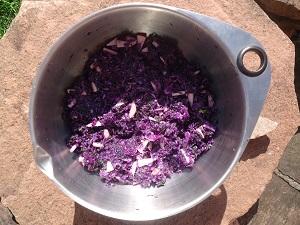
- Sauerkraut... the crock has come out of its summer hiding spot:

To make the first batch of fall sauerkraut, cabbage from the Martin's Farm Stand.
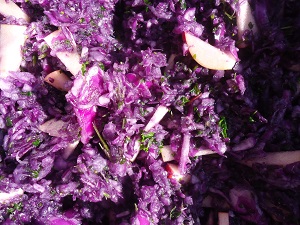
The close up, below, displays the green bits of parsley from my front yard herb garden, the green bits of stinging nettles harvested from my yard (I am assuming the sting will leave during the fermentation process much like it leaves during the cooking process), and the chunks of local apples from the Martin's.
I make sauerkraut because:
- Sauerkraut is good for gut microbes,
- I can use local cabbage and preserve it for weeks,
- It is quick and easy to make a batch that will be about 3-4 quarts (takes me about 30 to 40 minutes including clean up),
- and, after sitting for 10 to 14 days I have 3-4 quarts of food that will enhance meals and fall root veggie salads for 2-3 weeks.
- I have just enough time to ferment another crock with different goodies added to the cabbage: beets, carrots, celeriac, grated (raw) squash, parsnips, turnips, rutabaga.... before the current batch is gobbled up!
For a kraut recipe, click here. No crock to ferment in? No worries, use wide mouth ball canning jars.
Enjoy!
PS I confess, I no longer use the hand grater (see my grating picture in my kraut recipe blog post that I linked above) to grate my veggies. I use my food processor. It cuts the prep time in less than 1/2!
Souped Up Soup!

Yesterday I posted about my "take a peek into the produce bins and concoct some sort of soup for dinner" experience in the kitchen. I commented that tonight's soup would be similar but with sautéed celery instead of the kale. (My apologies on the typo about "now add the onions and garlic" as it was supposed to be add the onions and kale. I fixed that boo-boo.)
OK, so the planned soup just got souped up. I discovered 4 buttercup squash, from Old Market Farm, in my garage last eve. Now I did not exactly lose them, they were just momentarily forgotten. I decided to get them into the house before they froze and started rotting on me.
So I roasted the squash this AM. Revving the oven up in early AM helps to warm the chilled downstairs after a cool night.
To make this soup quickly, on an eve after working all day: get the squash steaming first, before you sauté the celery and onions. Cut a small to medium buttercup squash in half, remove seeds, and put into a pot of water that has about 1 inch of water on the bottom. When water starts to boil, reduce heat to a gentle simmer, and cook squash for about 20 minutes. It will be ready when you finish with the sauté and soup prep.
Kitchen Advice: Never boil your veggies in a pot full of water; steam in the least amount of water you can get away with and not go dry. This goes for potatoes you are cooking to mash. Less water means less nutrient loss. Pour off cooking water into a coffee mug, let cool, and drink. Get every cell enhancing mineral and nutrient any way and every way you can!
Now get going on the celery & onion saute'!
- Sauté the medium sized onion, cut into small chunks, and the celery leaves in bacon fat from local, pasture raised pigs, no nasty curing chemicals added. (Use whatever you like for gentle sautéing: pasture raised butter, coconut oil... I would avoid most vegetable oils but that is another blog post and story!) The celery will sauté quickly, add the celery after the onions are just about finished. This way you do not over cook the celery leaves.
- Add approximately 3 1/2 cups of goat's milk to the blender with 3 big cloves of the Birdsfoot garlic.
- Add the onion and celery to the blender.
- Plop in big scoops of the squash, at least use one half of the cooked squash. Be careful scooping the squash out of the shell as it is hot and a steamed squash gets mushy not rigid like an oven roasted one. (Add lots of butter and sprinkle with curry, the other half of the squash, while it is still hot so the butter melts. Mash the butter and curry into the squash. Put into a dish and take to work tomorrow!)
- Sprinkle in, oh maybe 1 tsp. of medium heat curry powder (Nature's Storehouse or the Potsdam Food Coop). I use more curry with squash or pumpkin soup because the squash flavor can handle it without being overwhelmed. Besides, the spices in curry are amazing healers!
- Blend until the consistency and smoothness you want in a cream soup is achieved.
- Pour in soup pot and gently warm.
- Ladle into soup bowls and add a pinch of unrefined sea salt, if desired.
Don't forget the beet gratings! Beets soup up the soup in several ways:
- fiber
- nutrients
- raw veggie with dinner
- contrasting color to the pretty orange soup (this artsy cooking style feeds the heart, mind, and soul!)
- beets are used as cancer therapy in Germany and Russia! Why wait to use as therapy; prevent health problems now!
Quickly grate the beet using my metal cheese grater. I sprinkled the beet gratings on top of this generously curry seasoned cream of squash/celery soup.
If the pot is big enough, or the eaters few enough, you will have left overs for lunch or later dinners this week! OR... freeze in a wide mouth, quart Ball canning jar (leave head space for expansion during the freezing process) and enjoy in a week or two!
Cheers and happy, healthy cooking!
Cream of Kale Soup... and more!

I am big on the:
Look in the produce drawers, see what seasonal produce I have on hand, and throw it all together
kind of cooking.
My peek into the produce bin came up with a bouquet of kale; gratitude goes to the Kent Family Growers. I had an onion from the Martin's and plenty of garlic from Birdsfoot Farm.
To me this looked like the makings of a good pot of soup, so...
- Saute' the medium sized onion, cut into small chunks, and the bouquet of kale, cut into thin strips, in bacon fat from local, pasture raised pigs, no nasty curing chemicals added.
- Add approximately 3 1/2 cups of goat's milk to the blender with 3 big cloves of the Birdsfoot garlic.
- Add the onion and kale to the blender.
- Sprinkle in, oh maybe 1/2 tsp. of medium heat curry powder (Nature's Storehouse or the Potsdam Food Coop).
- Blend until the consistency and smoothness you want in a cream soup is achieved.
- Pour in soup pot and gently warm.
- Ladle into soup bowls and add a pinch of unrefined sea salt if desired.
Then I discovered a beet, my beloved beets, in the refrigerator. I quickly grated the beet using my metal cheese grater. I sprinkled the beet gratings on top of this gently curry seasoned cream of kale soup.
It was divine! (And it took maybe 20-25 minutes!)
Tomorrow night will be a repeat cream soup but I will be sautéing the celery leaves from a large head of celery from the Keim Amish Family Farm. Add onion, goat's milk, garlic, curry... and, yes, the grated beets on top!
Any good stories from your kitchen about throwing together a soup after just a peak into the produce bins?
Happy cooking and eating!
Please Remove Shoes & Negative Attitudes

I painted this door sign years ago. I have glued and removed it from a couple of front doors. I was inspired to create it because of a bumper sticker: "Mean People Suck." I also related that sentiment to negative people and their energy.
This past Saturday I watched the documentary film Symphony of the Soil. I was reminded of the beautiful method of how soil rebuilds itself when we care for it in natural ways, recreating nature's gardening methods.
Another message that was clear to me: how farming with chemical fertilizers, pesticides, fungicides, and herbicides is much like fraternizing with negative people - soil / soul sucking!
These chemical means of farming literally suck the life out of the soil. Chemicals slowly and insidiously kill off the soil microbes, fungi, earth worms, and various other life forms that are essential to healthy soil and life on this planet. Chemically farmed soil becomes dry, pale, lifeless, and infertile. Food grown in this soil is nutrient deficient like the very soil it was grown in.
Negative people and negative energy (i.e. watching, listening, or reading the news) do the same to us. These things slowly and insidiously suck the life from our body, mind, and soul. Negative energy in our life is a real force that leeches the nutrients from our every body cell just as chemical farming leeches nutrients from the soil.
Chemical farming is a stress to the soil, to all biological life, and to this planet. (All are one and the same.)
Negative people and negative energy stress our physical body, our emotional/mental being, and our soul. Negative energy activates the stress response. This response eats up nutrients from our body cells. This is one reason why stressed people get sickly looking (pale like the stressed soil), age faster, and contract more acute illnesses (colds, the flu, etc.) and go on to develop more chronic lifestyle diseases than relaxed, peaceful people.

Touch each other's lives, and your own, gently! Northern Sun T-Shirt!
POSITIVE Action to take:
Surround yourself with warm, loving, positive energetic people
AND
Be a warm, loving, positive energy person!
See and inspire the good in everyone, including you!


Whole food RECIPE: Tourlou Greek Mix-Mix (made with local ingredients!)
This is positively delicious!
- 5-6 medium ripe tomatoes (Richard Paolillo's & Vanessa Bittner's Old Market Farm)
- 1 medium eggplant (Kent Family Growers)
- 2 medium red potatoes (Keim Amish Farmer)
- 1 large red pepper (Keim)
- 1 large red onion (Birdsfoot Farm)
- 4-5 good size cloves of garlic (Birdsfoot Farm)
- 2 bay leaves
- 1/2 cup olive oil (I used 1/4 cup olive oil and 1/4 cup of Kriemhild Dairy's pasture raised butter)
- dash of nutmeg and thyme, I am a heavy handed dasher! I would say a good full tsp. of thyme and slightly less than a tsp. of nutmeg
- unrefined sea salt and fresh ground black pepper to taste after cooking

The finished Tourlou, Mix-Mix, with chickpeas.
- Cut veggies into bite size chunks and mix together well (except garlic)
- Spread out in the bottom of two 8 x 13 baking pans
- add oil, butter, bay leaves, nutmeg, and thyme and mix together
- Bake at 350 F for 1 hour, set timer for every 20 minutes and mix-mix away adding water to not "fry" the veggies! This makes for a juicy creamy mix-mix!
- If veggies not tender enough after 1 hour, give them a few minutes more
- When finished cooking add the garlic via garlic pressing into the mix of veggies
- Serve and add salt / pepper to taste
- Serve with chick peas added to the mix or chunks of chicken
- A side of whole grain pita bread, warm of course, is nice
- Perhaps a 'lil Greek goat's milk feta too!
Hints:
- This dish can be eaten hot or cooled. Traditional Greek serving is when cooled allowing the flavors to meld.
- I have used zucchini, yellow squash, buttercup & butternut squash, sweet potatoes... The eggplant, tomatoes, and onion are required... after that, add veggies to your delight. The more you make, meaning the fuller the baking dishes are, use more tomatoes to add to the creamy goodness.
- Another serving suggestion: To get a raw veggie salad in with this yummy dish serve with a Fall cabbage-root veggie slaw OR sauerkraut.
Enjoy!