
Bone Broth: What Is the Hype?
Perhaps you remember your mom or grandma feeding you chicken soup when you were ill. Most chicken soup, stock, was made with the bones, cartilage, and the hunks of attacked chicken meat. (If you are vegetarian or vegan… don’t bail on me just yet. I have plant based gut healing suggestions as well. Bare with me on this bones thing.)
Animal bone broths have been used for hundreds of years, thousands really, for their nourishment and healing benefits. People inherently knew the healing benefits of the daily food and life choices they made. Modern living somehow now requires scientific proofthat what we are doing is worthwhile. Research into the benefits of bone broth is available and plenty to satisfy the scientifically inclined.

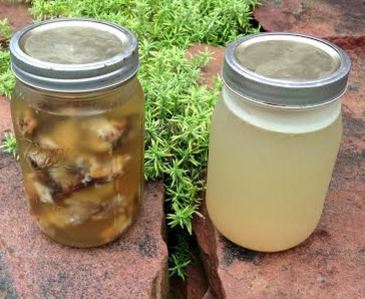
Jar one: bones soaking in apple cider vinegar
Jar two: finished bone broth
I originally wrote this for the Potsdam Food Co-op's August 2016 Newsletter.
Perhaps you remember your mom or grandma feeding you chicken soup when you were ill. Most chicken soup, stock, was made with the bones, cartilage, and the hunks of attacked chicken meat. (If you are vegetarian or vegan… don’t bail on me just yet. I have plant based gut healing suggestions as well. Bare with me on this bones thing.)
Animal bone broths have been used for hundreds of years, thousands really, for their nourishment and healing benefits. People inherently knew the healing benefits of the daily food and life choices they made. Modern living somehow now requires scientific proof that what we are doing is worthwhile. Research into the benefits of bone broth is available and plenty to satisfy the scientifically inclined.
After the long soak and simmer to make bone broth (recipe to follow), the resultant gelatinous and slightly fatty liquid contains valuable minerals and nutrients in a form your body can easily absorb, circulate in your bloodstream, and be taken in and used by your body cells. These nutrients include amino acids, calcium, magnesium, phosphorus, potassium, silicon, sulfur chondroitin, glucosamine, collagen, and a variety of trace minerals and other nutrients. The gelatin in bone broth supports gut lining health, gut lining healing, and proper digestion.
Bone broth has been proven to help with infection fighting (why Mom and Gram gave you chicken soup when you were sick with the cold and flu). Bone broth contains amino acids that easily nourish the body on the cellular level. L-arginine and L-glutamine are two nourishing amino acids present in bone broth that decrease inflammation in the gut (and whole body inflammation) assisting the immune system in its never ending job of fighting infections and inflammation. L-glutamine is known for its gut health enhancing properties. L-glutamine helps to heal and seal the lining of the digestive tract, your gut. More L-glutamine information coming up.
Many issues of modern living (antibiotics, hand sanitizers, modern wheat-gluten and dairy, chlorine and fluoride in drinking water, household chemicals, cosmetic chemicals, glyphosphate and other industrial agricultural chemicals… the list is never ending) create inflammation in the gut. An inflamed gut lining creates problems that allow undigested particles of food, chemicals, microbes, etc. to directly enter into the blood stream. This happens because the gut inflammation creates a diseased small intestinal condition medically named increased intestinal permeability.
This dis-ease of the body’s small intestine is more commonly known as Leaky Gut Syndrome. The small intestine has junctions that are very tightly packed together. These tight junctions serve a wonderful purpose by keeping unwanted particles (chemicals, bacteria, viruses…) in the digestive tract to be dealt with and passed out in solid waste OR food digested down to the smallest particles* to be absorbed, circulated, and used for cellular nutrition.
· *Carbohydrates to simple sugars
· *Proteins to amino acids
· *Fats to fatty acids
The issues of modern living, mentioned above, create inflammation that irritates and erodes away at the gut and loosens these tight junctions. When these junctions are loosened all hell breaks loose in the body. The above mentioned substances pass through the now loose junctions directly into the bloodstream. This is not meant to be. The substances are meant to be digested first, cleaned up by the liver, and/or pooped right out of the body. When they slip into the circulation because the junctures are no longer tight to keep them where they belong… your immune system goes postal on them. Antibodies are created to combat these substances that are seen as foreign invaders, antigens. The next time you eat or take in one of these substances, the substance moves into the bloodstream through the loose junctures setting off the immune system (The immune response to this now problem food or substance actually happens before the food even reaches the intestines). This time the immune system has the antibodies ready and war is waged on the substance, the assumed antigen. Over time the body wears down from this cycle of inflammation, gut juncture loosening, seepage of the unwanteds into the blood stream, and a result can be that the body starts attacking itself (auto-immune issues).
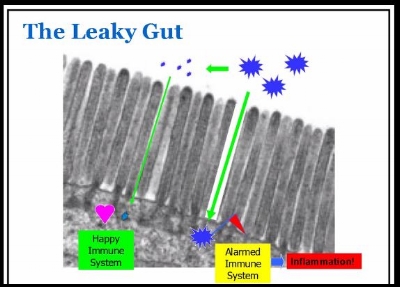

Above 2 photos used with permission of Tracy Harrison – http://www.wildlysuccessfulhc.com/ Photo #1 shows tight junctures and loose junctures in a simplistic drawing. Photo #2 inside of small intestine showing a very blown up view of the thousands of villi covered by millions of micro-villi. These villi are where the junctures exist.
My gut story is a very simplistic explanation meant to assist in the understanding of what in the body is going awry. An inflamed gut lining contributes to leaky gut syndrome and the resultant food sensitivities and allergies, auto-immune conditions, and many other inflammatory body issues leading to a host of dis-ease. (Dis-Ease being a lack of ease in the body; lack of health.)
L-Glutamine, contained in bone broth, is a gut junction healer. It helps to soothe the inflamed gut and heal the loose junctions back to their tight junctions. Tight junctions are immune and whole body health enhancing.
Now you know some substances and habits that can contribute to leaky gut issues and how bone broth plays a crucial role in the healing of this condition. It is time to tighten up junctions everyone; time to learn how to make bone broth. (Again, I have added vegetarian and vegan suggestions to mimic, as closely as possible, bone broths healing benefits to your gut and body’s health.)
Making Bone Broth:
By the way… bone broth Cafés are now quite popular in metropolitan areas.
Bone broths are made with fish, chicken, turkey, beef, pork, and lamb bones in water. Different animal bones and tissues have different nutrients and benefits. (Buffalo, venison, rabbit, wild bird bones are fine as well.) Use only bones, cartilage, feet, tails, etc. from pasture raised or wild animals. Never use bones from commercially raised animals (factory farm animals) that are given anti-biotics, hormones, and/or fed genetically modified feed (corn, soy…). You are what you eat and animals are what they eat. If unhealthy substances were used in the raising of the animals, those substances will be concentrated in the animal bones and body tissues, and therefore concentrated in your finished bone broth.
1. Put slightly meaty bones, cartilage, feet, tails, etc. (they do not have to be stripped clean of meat) in a sauce pan or big soup pot (if you have a lot of bones) and cover with water, just enough to cover bones well. I break up the bones as best I can and squish them down into the soup pot bottom.
2. Add a generous tablespoon of raw apple cider vinegar (ACV) and cover the pot. If you are doing a big pot of bone broth use more of the ACV. For estimation purposes I use a heaping tablespoon of ACV for a whole chicken’s pot of bones.
3. I soak the bones in the vinegar water for at least an overnight and then…
4. I slow simmer the bones for hours the next day. I gently bring the bone filled pot to a simmer on the stove top.
5. I then place the pot o’ bones in a pre-heated 220 F oven and leave for 5-6 hours if chicken or fish bones and longer if the harder bones of pork or beef (at least 6-8 hours). Yes, a crock pot works well. You could simmer for hours on the stovetop but I find the oven temp is easier to regulate and keep the simmer from boiling away the broth. Cool fall and cold winter days make for extra warmth in the kitchen with the oven going. Slow roast something for dinner to get extra bang for your buck using the oven for so long.
6. After simmering, I remove the bones with a large slotted spoon. Use the broth as a soup stock or eat the broth as it is, drink it like a morning or evening cup of tea. I add a bit of unrefined sea salt to taste.
7. If making soup, I sauté the veggies and other soup ingredients before adding them to the hot bone broth. This avoids further simmering of the broth.
8. Toward the end of bone broth simmering you can add herbs** that contribute to the anti-inflammatory effects: turmeric & ginger root, rosemary, thyme, oregano… allow the herbs to gently simmer (that 220 degree oven is hot enough) for an hour if a leaf/flower and simmer for 2 hours if a bark/root/seed. (Similar information is the making of herbal tea infusions: http://www.paulayoumellrn.com/making-herbal-infusions-teas/ )
9. When I re-warm the broth for sipping I will sometimes add small amounts of marshmallow root powder, slippery elm bark powder, and/or licorice root powder. These herbs are anti-inflammatory and also contribute to the soothing effect; the heal and seal for the gut lining.
10. Using a large slotted spoon, remove the bones from your finished broth.
Now what to do with it?
- Put into glass canning jars and refrigerate until ready to use.
- Drink one or two cups daily, gently warmed up, like a tea.
- Use it as soup stock.
- Freeze to use later as bone broth tea or soup stock.
I often keep my bones soaking in the vinegar solution for days or weeks. I keep the bones in a wide mouth canning jar in the fridge. I add bones to this jar until I have enough to justify making bone broth and/or the outside temperature is cool enough to be ok with my long oven usage. With fall and winter just around the corner, sorry dear Co-op friends, it is a good time of the year for long cooking of bone broth.
Enjoy making and sipping bone broth.
**This is part of my vegetarian and vegan friendly information for enhancing your gut health through plant based choices…
Thanks for hanging in there and continuing this read. As a vegetarian or vegan you can cook up vegetable broths that are enhanced with the above herbs.
· Slippery elm, marshmallow, and licorice root have coating and soothing effects on the gut lining. I use them in many ways as bonus gut health foods – teas or the powdered herbs mixed into plain/full fat yogurt with added L-glutamine powder.
·Add red cabbage to your soup as it is a plant based source of L-glutamine. Red Cabbage is considered the densest vegetable form of L-glutamine. Making red cabbage sauerkraut is another great way to use cabbage and create a highly bio-available form of l-glutamine.
·Other sources of L-glutamine to help tighten up those junctions: the highest levels found in grass-fed beef, bison, chicken, and free range eggs. Raw dairy products from grass-fed cows and goats are also very high in L-glutamine.
·Plant sources: almonds, pistachios, walnuts, pumpkin seeds, sunflower seeds, peanuts and peanut butter are all good sources (peanuts can be disturbing to gut health in people with pre-existing gut issues). Dried lentils, peas, and beans contribute L-glutamine as well. Other vegetables sources include spinach, parsley, and beets.
·It is best if these vegetables are consumed raw or fermented in order to maximize their glutamine content and increase bioavailability. Cooking heat, especially high heat, breaks down the L-glutamine.
·A recipe for using raw, red cabbage in fresh slaws: http://www.paulayoumellrn.com/winter-salad/
·Making sauerkraut with red cabbage: http://www.paulayoumellrn.com/blog/2014/02/04/i-popped-the-cranberry-of-fermentation
Conveniently made for you bone broth in Canton-Potsdam area:
- Potsdam Food Co-op in Potsdam carries Pacific Organic bone broths, in aseptic packages, on the grocery shelf.
- Nature's Storehouse in Canton carries Bonafide organic beef broth in their meat freezer.
2 websites for further learning about bone broth and healing the gut lining (type "bone broth" or "leaky gut syndrome" into the website's search bar):
Immune MishMash in the kitchen

When a touch of the flu hits your home be prepared with some tools to boost the immune system:
- Brothy soups (bone broths are nice)
- Elderberry syrups or tinctures (Check out my elderberry article in the next Potsdam Food Co-op's newsletter, coming soon)
- Flu tonics: (No Time For Getting Sick, everyone around me was sick and needing my care, I had to be the one to stay functioning!)
- Herbal teas: nettle, yarrow, rosemary, peppermint (Instructions for making medicinal infusions, teas, click the herbal teas link
- Hot baths with plenty of water (or the above immune herbal teas) to drink while bathing. Fevers need to be kept hydrated and allowed to do their work. A fever's purpose is to destroy the microbes causing the sickness with their heat. Fevers are part of your immune response for healing infections. If you reduce fevers with medications and cold baths, the heat of fever cannot work for you. Keep the feverish person very well hydrated to avoid the problems of fever that people fear.
- Whole food green drink such as SuperFood Plus
- Foods rich in:
- Vitamin C (lemon water?),
- selenium (brazil nuts anyone),
- zinc (pumpkin seeds?)
I was making a pot of soup, pictured above, to offer something brothy for my sick kid's bodies. The flu hit and one kid had a fever for 11 days. Mom care was required. As I am making the soup, "extended fever boy" is lying on the couch around the corner and says to me:
Jake: "What are you making for dinner Mom?"
Mom: "Soup"
Jake: "Your soup is scary to me. It always contains one or more of the following:
- animal carcasses (bone broths)
- rotting bean matter (miso)
- vegetables that most of the modern world have never heard of!
Mom: "Thanks for the vote of confidence."
Jake: "I don't appreciate finding scary things in my scary soup. The soups usually taste good but what is in it terrifies me. I observe it very carefully before I eat it."
Makes a Mom run to the kitchen to create healthy fare for her loved ones!
The Soup Recipe
- Bring 3-4 cups of water to simmer, slowly, no need to boil. Keep pot covered and on lowest heat.
- Saute' a medium onion chopped into fine slivers. Saute' in butter from pastured animals, animal fat, or coconut oil.
- Grate or finely chop cabbage, about 1 cup.
- Grate a small celeriac.
- Add both to onion saute' and quick stir fry.
- Add above veggie mix to the simmer water and keep heat as low as possible. Do not boil this soup.
- Finely chop kale and saute', about 1 cup.
- Grate a carrot and add to saute'.
- Toss into saute' some frozen red pepper strips that you perhaps froze before growing season ended.
- Stir fry all 3 together and add to veggie soup mix in pot.
- Add a pinch or two of cayenne to soup.
- Peel and press 1-2 cloves of garlic into soup.
- I then added 3-4 tablespoons of South River Miso's Sweet White Miso.
- Last addition was the flu syrup sitting on the counter. It contained raw apple cider vinegar, raw honey, garlic, onion, ginger, and turmeric. There was 2/3 to 3/4 a cup left in the jar. I dumped it all into the soup and stirred it up.
- Soup was finished and ready for serving to my terrified kid.
The only thing else I would have added, had I some bone broth on hand, would be bone broth instead of the water at the beginning. I recommend keeping bone broth made and frozen in wide mouth quart canning jars for flu emergencies.
Happy immune boosting soup making. I hope you efforts are appreciated and not creating a reign of soup terror!
Making Bone Broth: From my educational handout on bones and minerals
Bone broths are made with fish, chicken, turkey, beef, and lamb bones and a tablespoon of vinegar to liberate the minerals. Put bones in a sauce pan, soup pot and cover with water, just enough to cover bones. I squish the bones down into the pot. Add the tablespoon of raw apple cider vinegar and cover the pot. I soak the bones in the vinegar water overnight and slow simmer for hours the next day. I gently bring to a simmer on the stove top. Then I place in a pre-heated 220 F oven and leave for 4-5 hours if chicken bones and longer if harder bones. Remove bones and use as a soup stock for veggie soup or eat the broth as is (add a bit of unrefined sea salt to taste). If making veggie soup, I saute' the veggies before adding to the hot broth to avoid simmering the broth anymore.
Skin Care the Whole Food Way (and support for teen acne)


Those who know me know that my eating habits revolve around only real, nature made foods for this gal. No Ho-Hos, Twinkies, Doritos, and sodas for me.
I take care of my skin in this same Wise Woman way. If I would not put some substance in my digestive tract, why would I put it on my skin?
Call to Action: Take a very close look at the ingredients in the products that you slather on your scalp, face, arm pits, and overall body skin to cleanse, moisturize, deodorize, medicate, etc.
Would you put all of the ingredients in those products onto your plate?
Every ingredient will soak through your skin and be circulated around to every body cell. That's correct, every chemical becomes part of your cell makeup.

So what is a wise person to do to avoid all this crap in their skin care products?
Read ingredients like a chemical, refined ingredient detective, just as you do with your food.
Buy 100% natural products.
Make your own skin care products.
Re-evaluate all the products you keep in cupboards, drawers, and medicine cabinets. Are all of these lotions, potions, gels, sprays, deodorants, etc. really needed? I bet you can pare down to the bare necessities and save $$$ as well as chemicals on and in your body.
Good Skin Care Consists of:

Whole Food Feeding your body to prevent skin diseases, rashes, aging (wrinkle), and pre-mature degeneration of the skin. If you understand these whole food principles... skip clicking on the link back there and move along.
Whole Health Lifestyle Choices: Your skin is one of the first areas of the body to show signs of poor nutrition and lifestyle habits. The advice about the link above is the same here... if you are well versed in whole health living just move along.
Wise sun exposure. We need skin exposed to the sun to make Vitamin D. What we naturally make in our own skin is readily available for the body to use. Low quality Vit D supplements are not so easy for your body to use and add to toxic build up.
Avoiding soap. I know, sorry on this one as I am certain I will be ruffling some feathers. Your skin has a slight acid mantle. This acidity is your first line of defense against foreign invaders (i.e. micro-organisms). Soap is alkaline. Soap on the skin changes the acid PH and decreases your skins immune function. Your skin has to work harder to repair this acid mantle. Keep soap out of the picture and you protect and assist your skin as it goes about the task of covering and protecting your beautiful body. On another note: the slightly acid mantle of the skin keeps bacteria at bay... natural zit protection.
Occasional zits are one thing, acne is a whole other issue. Acne is a symptom of an unhealthy interior, poor food choices, a liver that is taxed and needs nourishing.
Onto Teen Acne... (truly anyone's acne will benefit)
I cannot emphasize the need for real, whole, natural foods to care for teen acne (to care for everyone all the time). If a kid is eating junk food crap that food is what is creating their cellular health, every body cell, and the toxins in junk food are excreted through the skin (through your digestive tract and urinary tract as well). Unhealthy skin is a symptom of unhealthy diet and lifestyle.
Yes, kids will have some zits with the craziness of teen hormonal shifts and their growth spurts. Acne can be seriously diminished and also prevented by a healthy lifestyle. Healthy living also balances teen hormones so they are not so all over the place. Modern living and eating has wrecked havoc on human health, teens included. See good skin care recommendations above.
Using low dose anti-biotics and birth control pills to deal with teen acne is an attempt at quick fixes that has disastrous long term consequences: serious disruption of healthy gut microbes, anti-biotic resistant bacteria, nutritional deficiencies, and so much more. Teen's skin (and bodies) are so much healthier when we function from a space of natural healing and avoid caving to quick fix pharmaceuticals with long-term damaging effects.
Teen Medicinal Infusion (Herbal Tea) OR Tincture
To compliment a whole food diet clearing toxins from the body and helping to heal acne, you can make your own herbal tea or tincture. Teas are easy to make and use within 30 minutes. Tinctures take a month or so to prep but last years.
To properly make herbal teas, infusions, go to this link
A simple formula I made for my kids, when they were teens, is my Zit Zapper Potion.
Red Clover for blood cleansing
Burdock & Dandelion Roots for liver nourishment of the detoxification pathways
Stinging Nettle Leaves for cell nourishment
Milk Thistle Seeds for liver nourishment to build liver health
To make a tea, see link above, you will have to follow the instructions for a decoction when infusing the hard plant parts of the Burdock & Dandelion Roots & the Milk Thistle Seeds.
I chop the roots into very small pieces and put them in the blender with the Thistle seeds. I blend quickly into rough chunky powder and then use for the decoction. I would chop 1 Tbsp of each of the 3 hard herb parts and make about 1/2 gallon of the tea.
After VERY gently simmering the hard parts for 20 minutes or so, shut off heat under your pot. Add the tablespoon of Stinging Nettle leaves and tablespoon of Red Clover flowers. I have both of these measured out and ready in a bowl. I use my fingers to break them into smaller pieces before putting into the root / seed decoction.
Once the soft plant parts are in the pot, stir gently, put pot cover back on, and let it sit and steep over night. The heat is off under the pot, no simmering of the soft plant parts.
Strain & refrigerate. Squeeze all tea from the wet plant parts.
Drink 2-3 cups daily. Measure out 6-8 ounces at a time, not a 12-16 oz. mug.
To make a tincture:
have 2 tablespoons of each of the 5 herbs in this formula
toss all into the blender and gently blend into soft, chunky powder
add 8 ounces of organic 100 proof vodka to blender and swirl around to get the plant pieces off the sides of the blender pitcher. No wasting plants!
Pour the plant vodka mixture into a pint or quart canning jar. Plastic lids work better than the 2 piece metal lids as the alcohol tends to eat up & rust the metal.
Get all materials out of the blender
label your jar with the herbs in it, date you made it, and the vodka you used. Store the bottle in a cupboard away from heat and light.
gently swirl the contents every day for at least a month.
After the month, carefully strain to preserve all of the liquid. Squeeze the herbs to get every last drop of your precious tincture.
Store the finished bottle in a cupboard away from heat and light.
Start of slowly taking 10 drops 2-3 times daily. After a week up to 20 drops 2-3 times a day. 3rd week: 30 drops 2-3 times a day. Skip one day a week. If some days you take twice and other days three times, that is perfect!
Now if you want to get really fun, learn how to make tinctures with the phases of the Moon. Some are made from Full Moon to Full Moon, some from Dark New Moon to Dark New Moon. Herbal medicine making is a gift to your healing adventure.

Teen Skin Wash

Put into a clean 8 oz jar:
3/4 cup water
1-2 tbsp. apple cider vinegar (the raw, unfiltered variety)
Optional: 1-2 drops of tea tree oil or oregano oil
Keep cover on tightly
Shake this jar well before using every AM & PM. Simply wet the corner of a thin cotton cloth (thick, fluffy wash clothes absorb too much of the liquid and waste it) and wipe across your entire face, neck, back, shoulders... wherever pimples plague you.
If you are showering, shower before using this vinegar wash. Splash your face with clean water, skip the soap, before applying if you are not showering.
Another Homemade Product suggestion: add 1 - 2 tbsp. of unrefined sea salt to above liquid and use as an underarm deodorant. The salt, vinegar, and essential oils work to prevent bacterial growth in your arm pits. Bacterial growth is what creates odor. This will not prevent perspiring like antiperspirants do. Antiperspirants are a whole other toxin to learn about, consider not using, and get out of your life. Stopping a natural process, perspiring, is never a wise choice. Perspiring is one way your body rids itself of toxins. Having bowel movements is another. How healthy do you think you would be if you used a daily anti-BM pill?

Questions, comments, some tried & true skin care thing you do? Please share in the comments.
More skin articles to read:
Naked skin care: apple cider vinegar products that maintain your skin's acid mantle (yes, you can also make your own!)
Secret face lift for making your own lotion
Stay tuned for next week's blog post on making your own natural sunscreen and anti-aging face cream.
Weight Loss with Chai Tea
My Yummy, Warm, Soothing, Morning Chai
Ah, caught your attention didn't I? I have discovered that when an article has information about weight loss it, that article:
Flies around the internet at break-neck speed and
Gets more reads than almost any other topics I write about.
Wait! Just one second there, don't you go clicking "delete!" I am a woman of my word and I DO promise to deliver on my weight loss information but I am wrapping it in a package with so much more. I want to sing the praises of Chai tea:
the health benefits of the spices and the black tea, (herbs and spices are so medicinal!)
the calming ritual of making and enjoying it (sharing it with loved ones too; like how about a Valentine's Chai Party with Girl Friends?! Guy Friends too! Share the Chai Love!), and
the thermogenic and weight loss benefits of sipping a bit of Heaven.
So how does Chai tea help with weight loss?

1. Herbs and spices can help boost your metabolism.
Black pepper increases your body’s metabolism and burns unwanted fats, including the fat on your belly. Black pepper stimulates blood and lymphatic circulation. Better fluid movement in the body creates better nourishment, better oxygenation, and better waste removal from body cells. This all stacks up to better metabolism and weight loss benefits. Black pepper contains a substance called piperine which blocks the formation of new fat cells.
Black tea has caffeine like compounds that stimulate metabolism. A healthy weight loss plan includes eating a 100% whole food diet and moving your body. Adding black tea can help keep your metabolism humming along at a healthy rate. (No, black tea will not help you burn the extra calories when indulging in high calorie foods. Whole food eating for weight loss is the answer. And, black tea's caffeine like properties are easier on the body than coffee. Coffee, in excess and over the long haul of life, tends to burn out the adrenal glands from over-stimulating them. Black tea has 1/2 the caffeine punch of a typical cup of coffee, unless you long brew - steep your tea bag or loose tea. Black (and green) tea has the balancing ingredient called l-theanine, an amino acid which promotes GABA uptake in the brain and is thus calming and helps to counter epinephrine surges. L-theanine also increases Dopamine. Thus, one can enjoy a nice combination of both focus and calm from tea. Tea is not as hard on the adrenals as coffee.)
Cinnamon (real Ceylon cinnamon, not cassia bark) increases your body's circulation of fluids. See black pepper above. Cinnamon contains compounds called polyphenols and the mineral chromium. Both of these compounds help improve how your body uses insulin in turn regulating blood glucose. Cinnamon has been shown to increase glucose metabolism by about 20 times, which would significantly improve your ability to regulate blood sugar.
Cardamom is another thermogenic herb that helps boost your metabolism and may boost your body's ability to burn fat.
Ginger is a warming spice that has anti-inflammatory properties. Ginger may have thermogenic properties that help boost your metabolism, as well as an appetite-suppressant effect. See ginger for its potential role in your weight management goals.
Nutmeg is a good digestive aid. When we properly digest food we better use the nutrients in the food. When body cells are better fed, better nourished, we do not crave food in unhealthy ways.
Some Chai recipes include turmeric as a spice to add to the mix. Curcumin, turmeric's most active ingredient, reduces the formation of fat tissue. Turmeric suppresses the blood vessels needed to form new fat tissue (it is an anti-inflammatory herb and excess fat formation is an inflammatory response) and therefore may help prevent fat build-up. Curcumin use, from turmeric, results in improvements in insulin resistance, hyperglycemia, hyperlipidemia, and other inflammatory symptoms associated with obesity and metabolic disorders.
Cayenne. Ok, this is not a regular chai spice. It just happens to be in the honey I gently sweeten my chai tea with. Cayenne is another thermogenic herb. Capsaicin is the compound that gives cayenne peppers their heat. Cayenne may help fight obesity by decreasing a person's calorie intake, lowers blood fat levels, and helps to shrink existing fat tissue.
2. Regular consumption of chai spices stimulates digestive and pancreatic enzymes.
See nutmeg above. Good digestion is key to obesity prevention, reduction, and healing.
3. There is also improved oxygen uptake and fat breakdown with chai spices.
This has to do with better circulation throughout your whole body, better digestion, and the stimulation to all body cells from improved circulatory effects.
Healing Suggestion: Herbs and spices of the thermogenic nature work best in the context of a whole food eating and whole health living plan. Herbs cannot help shed excess weight within the context of an unhealthy diet that is comprised of calorie dense and nutrient poor manufactured foods.
Making Chai Tea

Black tea of the organic nature, spicy / raw honey, chai spices, peppercorns, local / raw goat's milk.
First, I gather my chai ingredients:
black tea (sometimes I use loose black tea)
cayenne and ginger raw honey
a spice blend of cardamom, nutmeg, ginger, and cinnamon (I keep this pre-mixed in my cupboard)
I recently added star anise and cloves (use 1/4 cup each spice EXCEPT the nutmeg and cloves, 1 heaping tbsp of nutmeg, slightly less than 1 tbsp cloves)
black pepper corns in the mortar waiting to be ground
raw, local goat's milk
missing in the picture is the organic vanilla extract
Making the tea:
Bring 1 cup water to boil and turn off heat.
Add black tea, cover, and steep for 3 to 5 minutes. Yes, time this.
Remove black tea from how water.
Add 1 tsp. of chai spice mix.
Cover and steep 2 to 3 minutes.
Add 1/2 to 3/4 cup full fat milk from well raised and well fed lactating animals.
Cover pot and re-warm gently on low heat for a minute or so. Do not walk away or you will over heat and scorch the milk.
Grind the black pepper so you are not tempted to walk away to get that load of wash started.
Pour tea into tea mug.
Add a bit of vanilla.
Add ground pepper.
Add 1/2 tsp. or so of local, raw honey.
Stir, sip, enjoy, and relax!

Chai Tea and Me!
Are you looking at all the steps and saying... I don't have time for this Paula? Can't I just use one of those Keurig cups of chai tea? Sure go ahead but the above results are so much tastier. And the process becomes a meditative ritual. Think Asian Tea Rituals... sacred time.
Compare the taste a cup of Keurig coffee to a cup that you fresh grind the coffee beans and brew in a time honored fashion. There is no comparison.
Fast and easy is, well, fast and easy.
But taste is so much more! Would you prefer instant mashed potatoes or homemade mashed potatoes from local, organic potatoes cooked with the skins still on, mashed to perfection with plenty of butter from grass-fed cows, and a splattering of full-fat local raised, raw milk. Your choice! I am very clear on which one I would choose!
Share your thoughts. It is good to hear other's voices, thoughts, ideas...

Today... & Rethinking Winter Veggies

Rethinking Winter Veggies:
Here are two questioning comments I hear often around changing the diet to a whole food and seasonally based one:
- There are no vegetables that grow in Northern NY in the winter time. I have to purchase kale, cucumbers, tomatoes, and other vegetables that are grown in Florida and California. Otherwise, what would I eat?
- OK, so I am getting to know the local vegetables that are available in late fall and winter but what do I do with them?

My root veggie picture,
inspiring me from the kitchen wall!
A list of winter storage vegetables available in Northern NY:
- cabbage: red and green
- winter, hard squash (there are many varieties)
- beets
- carrots
- turnips
- rutabaga
- celeriac
- radish
- salsify
- burdock parsley root
- parsnip
- potato
- onion
- garlic
Farms and stores to purchase local (winter) vegetables in Northern NY: (I am certain this is not an all-inclusive list; investigate and find a farmer who grows good food near you!)
CSA Farms for Winter Veggies: (Again, not an all-inclusive list BUT to find more, go to www.gardenshare.com, Gardenshare's Local Food Guide and find a farmer near you who offers what you are looking for.)
OK, now for the cooking part. I am not going to put recipes here. I am more in favor of people learning to improvise in the kitchen: grab what you have and be creative based upon time honored methods of cooking and seasoning. Trust me, it is easy. Take a deep breath and just relax and let the cooking flow!
- Mashed potatoes are yummy! Try any of these root veggies in the mashed version, adding milk and butter. Try several root veggies steamed up and mashed together. Hint: When you steam, simmer, or boil the root veggie: use the least amount of water necessary and simmer gently. Maybe an inch of water in the pot, depending on the pot size and the amount of veggies. (Do not "rolling boil" them to death; it kills the flavor and the nutrients. As you boil off the nutrients you are boiling away the flavor!) Pour the "simmer" water off into a coffee mug and drink it. There will be just a little bit of water left by conservatively adding water and simmering gently.
- Roast any or all of the root veggies. Chop into bite size chunks, coat with your favorite oil sturdy enough to handle the oven heat, and roast for 35-45 minutes. Stir every 10 to 15 minutes and stab with a fork after 30 to test for tenderness. You want to create crunchy, cooked veggies, not mushy veggies.
- Soups, stews, stir fries are always good options.
- Squash, well... it is squash, roast it up. Steam them if you are short on time. Oven roasting can take 1 hour or more, steaming takes 20 minutes. A butternut squash, raw, grates up nicely into a winter veggie slaw. Just add chucks of apples, maybe a few raisins, and an olive oil - apple cider vinegar dressing seasoned with cinnamon, ginger, cardamom, and nutmeg.
- Cabbage is yummy in soups, stews, and stir fries. Saute' a pan of onions, potatoes, and cabbage and serve with your favorite protein.
- Make cabbage and grated root veggie slaws. (If you click that link back there, you will get one recipe from me! But... it is one I have given you many times!) This is my nightly favorite to add a "raw" salad to the winter meal fare: good fiber, good nutrients, and good enzymes from raw foods!

The above slaw is grated: red and green cabbage, celeriac, purple and orange carrots, and a Braeburn apple. The apple was so juicy I only added a bit of olive oil, a dash of cinnamon, and called it "dressed!"